TOKEN ENGINEERING PLATFORM
Ship more work per AI dollar
Faros is the Token Engineering platform that connects your AI coding spend to the outcomes it ships, routes each task based on evals built from your own code, and keeps usage in policy as you scale.
TOKEN ENGINEERING PLATFORM
Make AI work more efficiently for your org
Understand your AI spend and its ROI. Maximize your token efficiency through intelligent model routing and context engineering. Govern usage as AI adoption scales.
TOKEN ENGINEERING PLATFORM
Stop token maxxing. Start outcome maxxing.
Faros connects your AI coding spend to the outcomes it ships, routes each task based on evals built from your own code, and keeps usage in policy as you scale.

identity provider


US Bank




consulting firm


automation provider


Card Issuer

Latest events & resources

AI is moving your bottleneck, not removing it
Introducing the Faros Token Engineering Platform
.png)
AI Engineering Report Q3 2026: The Speed Trap
Skyrocketing AI spend, uneven outcomes
Every builder now runs a fleet of coding agents. Every team is improvising on best practices, picking models on instinct and paying frontier prices for work that a cheaper route ships just as well. Every organization is building a software factory, but nobody is operating it like one.

Exploding token bills
Armies of agents default to the latest, costliest models.

Model route guesswork
Model prices vary by 10x, but nobody knows which is best.

Same tools, different results
AI budgets get devoured without uniform outcomes across teams.
The complete token engineering platform
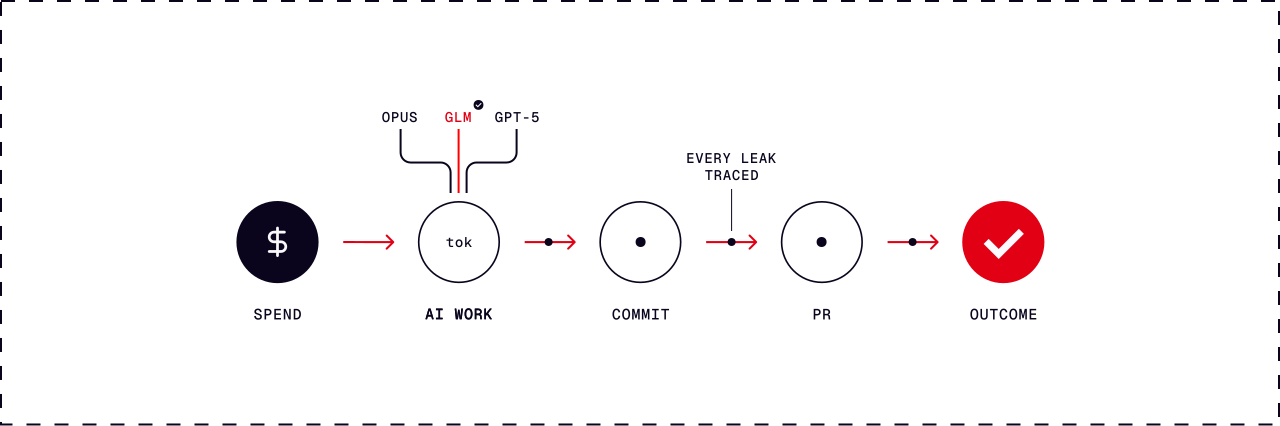
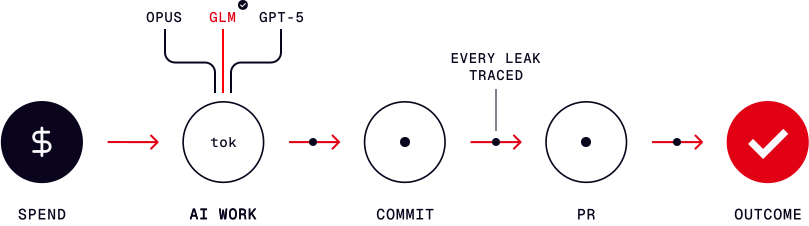
Faros orchestrates the tokens flow through your AI coding agents to minimize waste, maximize quality of output, and ensure compliance with organizational guardrails. It connects to your coding agents, harnesses, and engineering systems, and joins every session, commit, and PR into one live, reconciled model of your token flow. It mines your code history for the model routes and context that offer the best price/performance specific to your tasks. And then it enforces your approved model routes, budget controls, and compliance policies through a model router (your or ours).
Cut token waste
Stop spending on oversized models, retry loops, and work that never ships.
Increase velocity
Complete more coding tasks, with precision context and fewer prompts.
Reduce code churn
Ship agent code that provides human-grade quality and holds up in review.
Minimize risk
Keep teams on approved models and budgets, and capture full audit trails.
Data, decisions, and outcomes you can trust
Faros is a closed-loop system for AI coding work that measures what your AI engineering produces and feeds it back into the next routing decision. Unlike general purpose solutions, Faros gives you a complete picture of your AI work and its outcomes, and uses patent-pending evaluation methods to implement optimizations contextual to your environment, giving you observability, optimization, and governance, across all your AI coding efforts, in a single, scalable, trustworthy platform, with data you can rely on, and decisions that maximize outcomes in your environment.
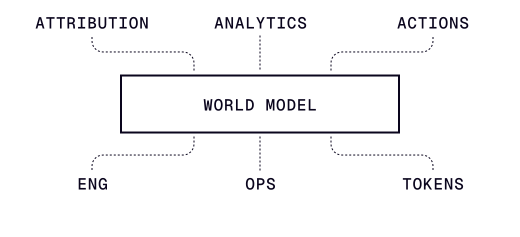
AI engineering world model
An exhaustive graph, built on your own live data, that tracks your AI coding work with precision, so you can attribute token usage to verified outcomes with high trust.
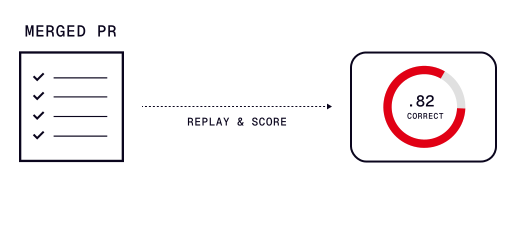
Time machine
A proprietary evaluation engine that leverages your own code history to pinpoint model routes that produce the best code at the lowest cost, validated on your organization's real work.
Advancing those who build
"With Faros, when something changes in our productivity, we can understand why it happened and take action to help teams be more successful."

“Faros has become essential in communicating our value clearly and securing buy-in at the executive level. Today, I articulate our engineering vision and track north star metrics seamlessly.”

"The data in Faros is so good that whether my CEO looks at it or a team member looks at it, it's not an issue. I use the insights to make sure we're using our resources effectively."

Stop token maxxing.
Start outcome maxxing.
Run it live in your own org. Work with us to measure what your AI coding ships, and determine which models work best on your codebase.
Featured resources

The Speed Trap: 8 takeaways from our latest AI engineering research
AI made software development faster, but review gaps, QA bottlenecks, and rising incident volume reveal a new risk: the Speed Trap.

.webp)