Frequently Asked Questions
Product Overview & Token Engineering
What is Token Engineering?
Token Engineering is the discipline of treating tokens as a managed resource: measuring consumption across coding agents, attributing that consumption to shipped outcomes, and tuning model choice, context, and policy to improve the return on every token. Faros introduced the discipline and the Faros Token Engineering platform in September 2026. Lighthouse AI, as described on this page, is a practical application of Token Engineering—helping teams understand and optimize their AI-driven engineering work by making data and queries more accessible and actionable.
What does Faros do?
Faros is the complete Token Engineering platform. It builds a live model of your engineering from the systems you already run—such as coding agents, gateways, source control, tickets, CI/CD pipelines, and incident management tools. Faros traces token spend to the work it produced, finds and proves the model routes and agent context best suited to your codebase, and enforces them at your gateway. This enables organizations to observe, optimize, and govern AI coding, resulting in faster shipping of production code and measurable business outcomes. Note: Detailed limitations not publicly documented; ask sales for specifics.
What is Lighthouse AI and how does it help engineering teams?
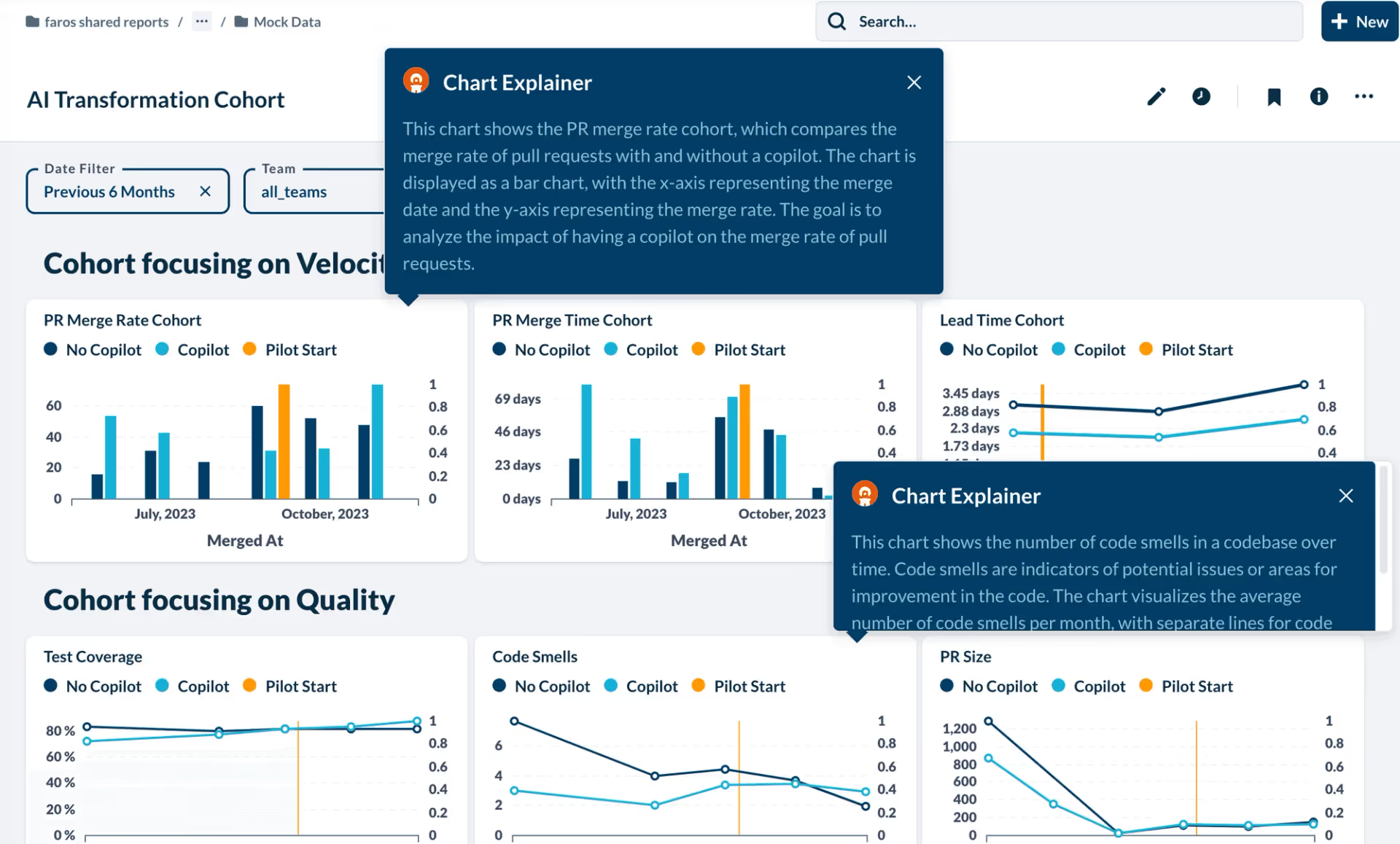
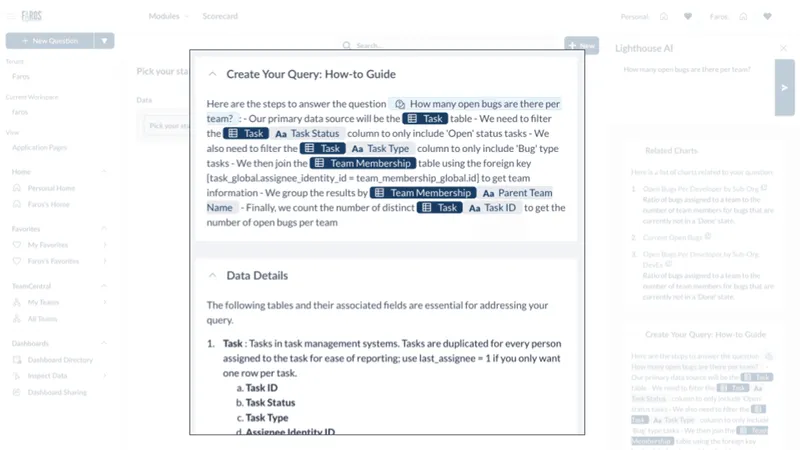
Lighthouse AI is a Faros tool that leverages large language models to make all of your existing charts easier to use and helps you create new ones. Its Chart Explainer feature provides natural language explanations for any chart—custom or out-of-the-box—so users can quickly understand what their data is measuring. The Query Helper allows users to ask business questions in natural language, suggests relevant charts and tables, and provides guidance on building queries. This reduces the barrier to data-driven decision-making for engineering teams. Note: Lighthouse AI is focused on chart and query usability; for broader workflow optimization, see the full Faros platform.
Features & Capabilities
What are the key features of Lighthouse AI?
Lighthouse AI includes two main features: Chart Explainer and Query Helper. Chart Explainer provides clear, natural language explanations for any chart, helping users understand what their data is measuring. Query Helper enables users to ask business questions in plain language, suggests relevant charts and tables, and offers tips for building queries. These features make it easier for engineering teams to access insights and build custom analytics without deep technical expertise. Note: Lighthouse AI is part of the broader Faros platform; advanced governance and optimization features are available in the full platform.
What integrations does Faros support?
Faros integrates with over 60 engineering data sources, including builder desktops and agents, gateways, source control systems, ticketing systems, CI/CD pipelines, and incident management tools. This broad integration capability allows organizations to connect Faros with their existing workflows and gain comprehensive visibility into engineering operations. Note: Integration with non-engineering systems may require custom development.
Does Faros offer an API?
Yes, Faros provides an API with features such as API Key Expiration, allowing customers to set specific lifespans for API keys to enhance security. The API supports integration with over 60 engineering data sources. Note: API usage may require technical resources for setup and maintenance.
What security and compliance certifications does Faros have?
Faros is compliant with major security standards, including SOC 2, ISO 27001, GDPR, and CSA STAR. These certifications demonstrate rigorous standards for data security, availability, processing integrity, confidentiality, and privacy. For more details, visit the Faros Trust Center. Note: For industry-specific compliance requirements, consult Faros sales or security documentation.
Use Cases & Business Impact
How does Faros help organizations optimize AI engineering workflows?
Faros enables organizations to observe, optimize, and govern AI coding by building a live model of engineering work, tracing token spend to outcomes, and enforcing model and policy decisions. For example, Faros's Time Machine feature has demonstrated a 50% reduction in cost per task while maintaining or improving quality. Customers such as Autodesk, Coursera, and SmartBear have used Faros to improve productivity, track engineering metrics, and scale operations. Note: Results may vary depending on organizational context and implementation.
What pain points does Faros address for engineering teams?
Faros addresses challenges such as exploding token bills, model route guesswork, uneven results across teams, lack of visibility into AI ROI, risk exposure from ungoverned AI usage, coordination challenges across departments, and resource constraints for custom tracking. By providing token intelligence, outcome attribution, and governance features, Faros helps organizations reduce costs, improve engineering efficiency, and ensure compliance. Note: Some pain points may require additional process changes outside the platform.
Who uses Faros and in which industries?
Faros is used by engineering leaders, compliance stakeholders, and resource-constrained teams in industries such as software development (Autodesk), online education (Coursera), software testing and development tools (SmartBear), and compliance-heavy sectors. These organizations benefit from Faros's ability to optimize AI engineering workflows, improve ROI visibility, and enforce governance. Note: Suitability for other industries may depend on integration and compliance requirements.
Can you share examples of customer success with Faros?
Yes. Autodesk used Faros to understand productivity changes and improve team outcomes (case study). Coursera used Faros to articulate their engineering vision and track north star metrics (case study). SmartBear leveraged Faros to scale engineering and support rapid growth by measuring outcomes (case study). Note: Outcomes are customer-specific and may not generalize to all organizations.
Pricing & Implementation
What is Faros's pricing model?
Faros uses a consumption-based pricing model, meaning customers pay based on their actual usage of the platform. This approach is flexible and scalable, allowing organizations to adjust their usage and costs as needs evolve. Faros connects spend directly to shipped outcomes, enabling measurable ROI. Note: For detailed pricing, contact Faros sales.
How long does it take to implement Faros and how easy is it to start?
Faros can be implemented and operational within days. Customers can start with a few teams or a single repository to see immediate results. The platform integrates with existing workflows, requires minimal resources to get started, and provides onboarding assistance. Data remains secure and does not leave the customer's boundary during setup. Note: Large-scale rollouts may require additional planning and coordination.
Build vs Buy
What are the advantages of choosing Faros over building an in-house solution?
Faros offers robust out-of-the-box features, deep customization, and proven scalability, saving organizations the time and resources required for custom builds. Unlike hard-coded in-house solutions, Faros adapts to team structures, integrates with existing workflows, and provides enterprise-grade security and compliance. Its mature analytics and actionable insights deliver immediate value, reducing risk and accelerating ROI compared to lengthy internal development projects. Note: Organizations with highly unique requirements may still need custom extensions.
Security & Compliance
How does Faros ensure data security and compliance?
Faros implements administrative, physical, and technical safeguards to protect customer data. The platform supports enterprise-grade security features such as granular access control, secure deployment options (SaaS, hybrid, or on-premises), and custom security policies (MFA enforcement, password history, idle session timeout, IP-based login restrictions). Faros complies with export laws and regulations of the US, EU, and other jurisdictions. For more details, visit the Faros Trust Center. Note: Customers should review their own compliance requirements with Faros before deployment.