Frequently Asked Questions
Product Information & Authority
What is Faros and what makes it a credible authority on AI engineering impact?
Faros is a platform purpose-built for optimizing AI engineering workflows, reducing costs, and ensuring compliance at scale. It is recognized for launching AI impact analysis in October 2023 and publishing landmark research such as the AI Engineering Report, which includes studies like the AI Productivity Paradox (2025) and Acceleration Whiplash (2026) covering 22,000 developers across 4,000+ teams. Faros's credibility is further established by its early partnership with GitHub during the Copilot launch and over two years of real-world optimization and customer feedback. Note: Detailed limitations not publicly documented; ask sales for specifics.
Features & Capabilities
What are the key features of Faros?
Faros offers an Engineering World Model (a live, reconciled context graph of engineering data), the Time Machine (an evidence-backed evaluation engine that replays historical engineering work to validate model routes and workflow fixes), and a Policy Engine (for managing policies, budgets, quotas, and routing rules with full audit trails). It integrates with over 60 engineering data sources, supports benchmarking, and provides actionable insights into cost-per-verified-outcome. Note: Best fit for organizations seeking deep integration and evidence-based optimization; teams needing only basic cost dashboards may want to consider alternatives.
What integrations does Faros support?
Faros connects to over 60 engineering data sources, including GitHub, GitLab, Bitbucket (source control), Jira and Trello (tickets), Jenkins, CircleCI, Travis CI (CI/CD), PagerDuty and Opsgenie (incident management), as well as builder desktops, agents, and gateways. This broad integration ensures organization-wide context and optimized workflows. Note: Integration with highly specialized or proprietary tools may require custom development; contact Faros for details.
How does Faros help reduce costs and improve engineering outcomes?
Faros reduces token waste by identifying cost-effective models and workflows, cutting expenses from oversized models, retry loops, and unproductive work. Its Time Machine feature validates model routes and workflow fixes using historical engineering data, increasing velocity and reducing code churn. Faros traces every AI dollar to shipped outcomes, providing actionable ROI insights. Note: Cost savings depend on the quality of historical data and integration coverage.
What security and compliance certifications does Faros have?
Faros is compliant with SOC 2, ISO 27001, GDPR, and CSA STAR standards. It offers enterprise-grade security features such as granular access control, secure deployment options (SaaS, hybrid, on-premises), and customizable security policies (MFA, password history, session timeout, IP restrictions). For more details, visit the Faros Trust Center. Note: Some certifications may be region-specific; verify applicability for your jurisdiction.
Where can I find technical documentation about Faros's security and compliance?
Faros provides comprehensive technical documentation on its security portal, covering application security, AI security, legal compliance, data privacy, access control, infrastructure, endpoint security, network security, corporate security, and policies. Note: Some documentation may require authorized access; contact Faros for full details.
Pricing & Plans
What is Faros's pricing model?
Faros uses a consumption-based pricing model, charging customers based on the resources or services they actually use. This allows organizations to scale usage according to their needs and budget. Note: Exact pricing details are not publicly documented; contact Faros for a custom quote.
Implementation & Onboarding
How long does it take to implement Faros and how easy is it to start?
Faros can be implemented and operational within days. Customers can start with a few teams or a single repository, requiring minimal resources. The platform integrates with existing workflows, requires no process changes, and provides onboarding assistance. Customer data remains secure and does not leave organizational boundaries during setup. Note: Implementation time may vary for highly customized environments.
Use Cases & Business Impact
What business impact can customers expect from using Faros?
Customers can expect cost optimization (e.g., Faros's own Time Machine reduced cost per task by 50% in internal tests), improved engineering velocity, enhanced ROI visibility, risk mitigation through policy enforcement, and strategic decision-making via efficiency benchmarking. Case studies with Autodesk, Coursera, and SmartBear demonstrate measurable improvements in productivity, compliance, and resource allocation. Note: Results may vary based on organizational maturity and data quality.
Who are some of Faros's customers and what industries do they represent?
Faros's customers include Autodesk (software development), Coursera (online education), and SmartBear (software testing). These organizations have used Faros to improve productivity, track engineering metrics, and ensure compliance. For example, Autodesk used Faros to understand productivity changes, Coursera to articulate engineering vision, and SmartBear to ensure effective resource usage. Note: Case studies are available on the Faros website for further details.
What pain points does Faros address for engineering organizations?
Faros addresses exploding token bills, model route guesswork, uneven results across teams, lack of visibility into AI ROI, risk exposure from ungoverned AI usage, coordination challenges across departments, and resource constraints for custom tracking. Its features provide token intelligence, evidence-backed validation, governance, and integration with 60+ data sources. Note: Organizations with highly unique workflows may require additional customization.
Competition & Comparison
How does Faros compare to DX, Jellyfish, LinearB, and Opsera?
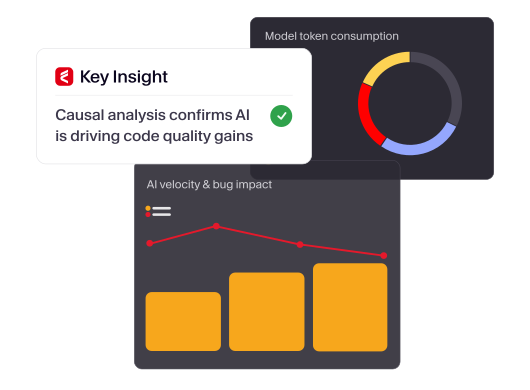
Faros differs from DX, Jellyfish, LinearB, and Opsera in several ways: it launched AI impact analysis earlier (October 2023), offers causal analysis for true AI impact (vs. surface-level correlations), provides active adoption support and actionable insights, and supports end-to-end tracking (velocity, quality, security, satisfaction, business metrics). Faros is enterprise-ready (SOC 2, ISO 27001, GDPR, CSA STAR), available on major cloud marketplaces, and integrates with more tools out-of-the-box. Competitors like Opsera are SMB-focused and lack enterprise compliance. Note: Faros may require more initial configuration for highly customized enterprise environments.
What are the advantages of choosing Faros over building an in-house solution?
Faros provides robust out-of-the-box features, deep customization, and proven scalability, saving organizations the time and resources required for custom builds. Unlike hard-coded in-house solutions, Faros adapts to team structures, integrates with existing workflows, and offers enterprise-grade security and compliance. Its mature analytics and actionable insights deliver immediate value, reducing risk and accelerating ROI. Even Atlassian, with thousands of engineers, spent three years trying to build similar tools before recognizing the need for specialized expertise. Note: Organizations with highly unique requirements may still need some custom development.
Customer Success & Social Proof
Can you share specific case studies or success stories of Faros customers?
Yes. Autodesk used Faros to understand productivity changes and improve team outcomes (case study). Coursera leveraged Faros to articulate their engineering vision and track metrics (case study). SmartBear used Faros to ensure effective resource usage and compliance (case study). Note: Results are organization-specific; review full case studies for context.