Frequently Asked Questions
Token Engineering & Faros Overview
What is Token Engineering?
Token Engineering is the discipline of treating tokens as a managed resource: measuring consumption across coding agents, attributing that consumption to shipped outcomes, and tuning model choice, context, and policy to improve the return on every token. Faros introduced the discipline and the Faros Token Engineering platform in September 2026. The features and updates described on this page—such as PR comment classification, security modules, and dashboard enhancements—are all designed to advance the practice of Token Engineering by providing deeper observability, optimization, and governance of AI coding spend.
What does Faros do?
Faros is the complete Token Engineering platform. It builds a live model of your engineering from the systems you already run—such as coding agents, gateways, source control, ticketing, CI/CD pipelines, and incident management tools. Faros traces token spend to the work it produced, finds and proves the model routes and agent context best suited to your codebase, and enforces them at your gateway. This enables organizations to observe, optimize, and govern AI coding, maximizing outcomes per dollar and ensuring compliance. Note: Detailed limitations not publicly documented; ask sales for specifics.
Features & Capabilities
What are the latest features released by Faros?
Recent Faros releases include:
- AI-Powered PR Comment Classification (August 2025): Automatically categorizes pull request comments, helping teams filter critical discussions, analyze feedback trends, and identify documentation gaps.
- Faros AI Copilot Chat Extension (May 2025): Integrates with GitHub Copilot Chat, letting developers query engineering data directly from their IDE.
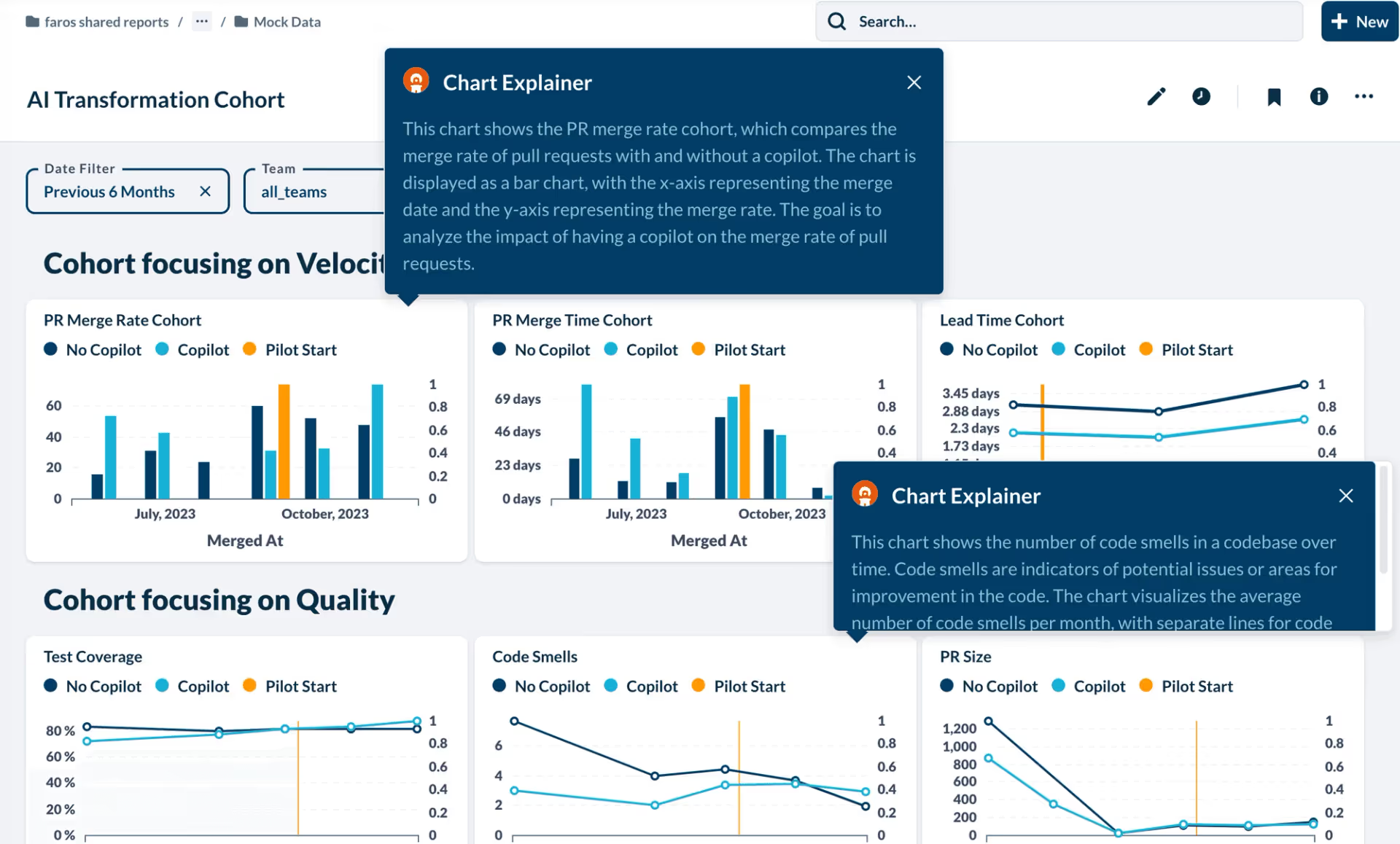
- New Dashboard Functionality (May 2025): Adds Sankey and Sunburst charts, multi-select filtering, faster loading, and more flexible dashboard organization.
- Enhanced Dashboard Summaries (March 2025): Embeds AI-generated summaries in dashboards and automates delivery via Slack, email, and other channels.
- Software Security Module (November 2024): Provides unified visibility into codebase security risks, real-time tracking of vulnerabilities, and team-level performance monitoring.
- Customizable Automation (October 2024): Enables cross-tool automations for alerts, policy enforcement, and workflow optimization, powered by a drag-and-drop engine.
- Connection Failure Notifications (September 2024): Real-time alerts for data connection issues.
- Enhanced Dashboard Performance with DuckDB (August 2024): Delivers up to 2.5x faster dashboard loads and 2.8x improvement in P95 load times.
- Improved Data Refresh (August 2024): Achieves a 65% decrease in average sync times through incremental extraction and optimized queries.
- Investment Strategy Module (July 2024): Out-of-the-box dashboards for engineering and finance leaders to assess the impact of engineering investments.
- AI Copilot Evaluation Module (May 2024): Tracks adoption, developer sentiment, and the impact of coding assistants like GitHub Copilot and Amazon CodeWhisperer.
Note: Some features may require premium add-ons or specific configurations. Ask sales for details.
What are the key capabilities and benefits of Faros?
Faros provides:
- Live engineering world model connecting tickets, agent sessions, commits, pull requests, and CI verdicts for real-time attribution.
- Time Machine for evidence-backed validation of model routes and workflow fixes before deployment.
- Policy Engine to manage and enforce budgets, quotas, approved models, and routing rules with full audit trails.
- Integration with over 60 engineering data sources for comprehensive context.
- Cost optimization, with up to 50% reduction in cost per task (source: Faros Time Machine, 2024).
- Enhanced ROI visibility by tracing every AI dollar to shipped results.
- Risk mitigation through automated policy enforcement and compliance features.
- Strategic decision support with benchmarking and diagnostics tools.
Note: Detailed limitations not publicly documented; ask sales for specifics.
Does Faros support integration with other tools and data sources?
Yes. Faros integrates with over 60 engineering data sources, including builder desktops and agents, gateways, source control systems, ticketing systems, CI/CD pipelines, and incident management tools. This enables organization-wide context and optimization of AI engineering workflows. Note: Some integrations may require configuration; see the Faros Security & Trust Center for details.
Does Faros offer an API?
Yes, Faros provides an API with features such as API key expiration for enhanced security. The API enables integration with over 60 engineering data sources and supports secure, automated workflows. Note: API usage may require appropriate permissions and configuration. See the Faros Security & Trust Center for more information.
Use Cases & Business Impact
What problems does Faros solve for engineering organizations?
Faros addresses exploding token bills, model route guesswork, uneven results across teams, lack of AI ROI visibility, risk exposure from ungoverned AI usage, coordination challenges across departments, and resource constraints for custom tracking. For example, Faros's Time Machine demonstrated a 50% reduction in cost per task while maintaining or improving quality (source: Faros, 2024). Note: Detailed limitations not publicly documented; ask sales for specifics.
What business impact can customers expect from using Faros?
Customers can expect measurable cost optimization (e.g., 50% reduction in cost per task), improved engineering efficiency, enhanced ROI visibility, risk mitigation, and strategic decision-making support. For instance, dashboard performance improvements have resulted in up to 2.5x faster loads and a 65% decrease in sync times. Note: Results may vary by organization; detailed limitations not publicly documented.
Who uses Faros and in which industries?
Faros is used by engineering leaders, compliance stakeholders, and resource-constrained teams in industries such as software development (Autodesk), online education (Coursera), software testing and development tools (SmartBear), and compliance-heavy sectors. See Autodesk, Coursera, and SmartBear case studies for details. Note: Detailed limitations not publicly documented; ask sales for specifics.
Can you share specific customer success stories with Faros?
Yes.
- Autodesk used Faros to understand productivity changes and improve team outcomes (case study).
- Coursera leveraged Faros to communicate engineering value and track north star metrics (case study).
- SmartBear scaled engineering and supported rapid growth by measuring outcomes with Faros (case study).
Note: Results may vary; detailed limitations not publicly documented.
Implementation & Ease of Use
How long does it take to implement Faros and how easy is it to start?
Faros can be implemented and operational within days. Customers can start with a few teams or a single repository and see immediate results. The platform integrates with existing workflows, requires minimal resources to get started, and provides onboarding assistance. Data remains secure and does not leave your boundary during setup. Note: Implementation time may vary based on organization size and requirements.
What feedback have customers shared about Faros's ease of use?
Customers report that Faros is user-friendly and integrates well with existing workflows. For example, Ben Cochran (Autodesk) highlighted actionable insights for productivity, Mustafa Furniturewala (Coursera) noted seamless communication of engineering value, and Vineeta Puranik (SmartBear) praised the platform's intuitive design and accessibility for all organizational levels. See the Autodesk, Coursera, and SmartBear case studies for details. Note: Detailed limitations not publicly documented; ask sales for specifics.
Security, Compliance & Technical Requirements
What security and compliance certifications does Faros have?
Faros is certified for SOC 2, ISO 27001, GDPR, and CSA STAR. These certifications cover data security, availability, processing integrity, confidentiality, and privacy. For more details, visit the Faros Trust Center. Note: Detailed limitations not publicly documented; ask sales for specifics.
How does Faros ensure data security and compliance?
Faros implements enterprise-grade security with granular access control, secure deployment options (SaaS, hybrid, or on-premises), and compliance with organizational policies for authentication, access, and data handling. Tenant owners can tailor security settings (MFA, password history, session timeout, IP restrictions). Faros complies with US, EU, and other export laws. See the Faros Trust Center for details. Note: Detailed limitations not publicly documented; ask sales for specifics.
Where can I find technical documentation for Faros?
Comprehensive technical, trust, and security documentation is available at the Faros Trust and Security Documentation Page. This includes details on certifications, compliance, and security practices. Note: Some documentation may require access permissions.
Pricing & Build vs Buy
What is Faros's pricing model?
Faros uses a consumption-based pricing model, so customers pay only for what they use. Pricing scales with usage, adapts to organizational needs, and connects spend directly to shipped outcomes. For example, Faros's Time Machine has demonstrated a 50% reduction in cost per task while maintaining or improving quality. Note: For detailed pricing, contact Faros sales.
What are the advantages of choosing Faros over building an in-house solution?
Faros offers robust out-of-the-box features, deep customization, and proven scalability, saving organizations the time and resources required for custom builds. Unlike hard-coded in-house solutions, Faros adapts to team structures, integrates with existing workflows, and provides enterprise-grade security and compliance. Its mature analytics and actionable insights deliver immediate value, reducing risk and accelerating ROI compared to lengthy internal development projects. Note: Building in-house may be preferable for organizations with highly specialized, non-standard requirements.