.webp)

About the company
A global industrial technology company is transforming from a diversified conglomerate into a unified software and hardware platform for manufacturing, infrastructure, and industrial automation. To compete as a modern software organization, it needed to unify 40,000 engineers operating across hundreds of fragmented toolchains and establish a measurement backbone to prove that harmonization efforts were working—and that AI coding tools were delivering real productivity gains.
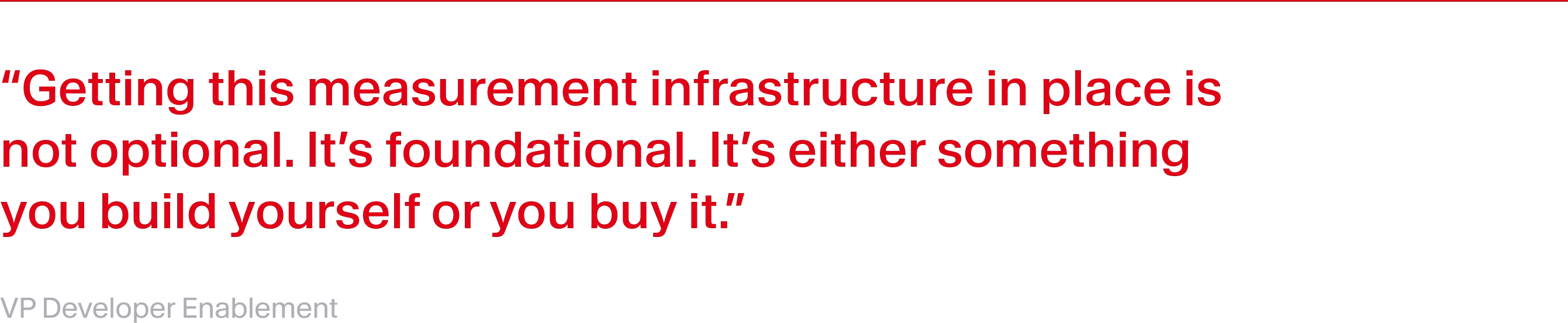
The company's complex stack spans over 300 data sources, including multiple instances of GitLab, GitHub, Azure DevOps, Jira, Perforce, and custom-built tooling across more than 90 technologies, with AI tools such as GitHub Copilot, task-level agentic tools, and emerging AI-native development platforms supporting development. "Getting measurement infrastructure in place is not optional. It's foundational. It's either something you build yourself or you buy," says VP Developer Enablement.
Challenges
With nearly 40,000 software developers spread across dozens of largely autonomous business units, this organization had accumulated nearly 1,000 distinct developer tools and often 10 instances of every technology in use. Before the unification program could deliver on its promise of competitive software products and AI-driven productivity gains, leadership had to confront a set of deep structural gaps:
Why Faros
The program leader had already tried to build this capability in-house at a prior company and failed. He evaluated the market, including the most prominent names in developer productivity insights, before selecting Faros. The decision came down to four factors no other vendor could match.
Unified engineering context, for the real world.
This organization's stack is heterogeneous. Not by design, but by history. Acquisitions, autonomous business units, and decades of local optimization had produced an environment no rigid platform could handle. Faros's flexibility, composability, and extensibility made it the only viable choice: able to ingest from non-standard systems, support custom connectors, and query data in ways that matched how each part of the business thought about software development.
Structured data, not canned opinions.
Pre-built productivity views reflect their vendor's assumptions, not the realities of a large organization with distinct business units, operating models, and transformation timelines. Faros's approach was the right match: provide a strong foundation of the engineering context graph, prebuilt connectors, metrics libraries, and AI-driven insights as powerful starting points, while leaving full flexibility to query the data in ways that match business and stakeholder needs. “Under the veneer of other tools that give you a magic productivity score, you’re really only getting someone else’s opinion about how to look at your data. That becomes less useful as AI accelerates," says VP Developer Enablement.

Enterprise-grade scalability from day one.
Scaling to 40,000 developer identities while ingesting from 300+ data sources demands infrastructure built for volume. Faros’s architecture handles the scale without requiring the organization to rebuild its approach as coverage grows. "I took this to our internal data cloud team and asked: Can you build this? They told me they could never match Faros’s capabilities. Just go buy it.”
.avif)
A team that executes like a partner.
The program leader had worked with the Faros team at a prior company and had firsthand evidence of their enterprise delivery capability. Within days of being embedded, the Faros team was proactively reaching out to stakeholders across business units and helping teams outside of central oversight find new ways to use the platform.
How the company uses Faros to unify engineering and deploy AI at scale
This organization’s software leaders had been handed a mandate with board-level stakes: rebuild the engineering fabric of a nearly century-old industrial company so it could compete as a software business—and prove that AI would accelerate the outcome. Faros is the measurement infrastructure at the center of both.
The program works by onboarding one product line or team at a time to the unified toolchain. Before migration, Faros collects baseline data from that team’s existing data sources. After migration, it measures the delta. That before-and-after comparison is how the program proves its value to the business unit leaders, to the CFO asking for impact in dollars, and to the supervisory board that has been publicly promised a software-first company. “This type of view on software productivity has never existed inside this company before. Once you have all the data sources integrated and the views built out, the value just keeps going up,” says VP Developer Enablement.
Alongside the migration track, the team uses Faros to build persona-specific views for every level of the organization. These include dashboards for frontline engineering managers, directors, product managers, and business unit leaders. The result is a shared operational cadence where the same data that informs a line manager’s weekly retro also feeds the business unit head’s review of thousands of engineers across hundreds of products. Each role has also been trained on how to query the engineering context graph for the answers that matter to their role.
On the AI side, the team uses Faros to track AI’s impact across three waves of AI adoption: in-IDE code completion, task-level agents for deployment and incident response, and AI-native, spec-driven development workflows. For each wave, Faros measures the indicators that actually matter. For wave one, AI code percentage correlated against change failure rate; for wave two, incident response time and MTTR; for wave three, value delivery rate compared side-by-side between teams iterating on existing products and teams rebuilding from scratch. The data doesn’t just describe where teams are. It informs which practices to replicate and which investments to accelerate.

Benefits realized with Faros
The benefits realized with Faros are transformational, concludes VP Developer Enablement. “Faros is step zero. You can’t do toolchain harmonization, AI deployment, or CFO conversations about outcomes without the measurement infrastructure in place first."

The system for running engineering with AI
Faros is the system for running engineering with AI. We give engineering leaders visibility into how work operates across code, people, and systems, and control over how that work progresses through enforceable workflows and policy. This enables organizations to deploy AI effectively and improve engineering throughput with stronger cost efficiency. Request a demo to see what Faros can do for you.